Friday, February 28, 2014
Slow Cooker Easy Potato Soup
When a friend shared this recipe with me, I couldn't believe that something so easy rivaled many homemade and restaurant potato soups I've had. It is so good!
Slow Cooker Easy Potato Soup
3 (10.5 oz.) cans condensed cream of potato soup, undiluted
3 soup cans of milk
2 (15 oz.) cans diced potatoes, drained
1(14.5 oz.) can sliced carrots, drained
1 1/2 cups diced ham*
salt and pepper to taste
1 cup instant mashed potato flakes
Optional toppings: sour cream, cheddar cheese, bacon bits
In a 6 qt. slow cooker, combine the first 5 ingredients. Add salt and pepper to taste. Cover, and cook on low for 3-4 hours. Right before serving, add the instant mashed potato flakes and stir. Serve with toppings if desired.
Click here for printable format
*If I don't have leftover ham in the freezer, I use Farmland Smoked Spiral Ham Slices and Pieces. I cut off any fat or rind and then dice enough to make 1 1/2 cups. The remaining ham can be frozen for the next batch of soup. :)
Cornbread is a good side with this soup, and I have an easy, delicious recipe for it!
Cornbread: http://easyaspiecanbe.blogspot.com/2014/02/cornbread.html
I adapted this recipe from the original recipe shared with me by my friend Constance.
Friday, February 21, 2014
Cornbread
This cornbread is tender, moist, delicious, and easy! No need to buy a mix ever again.
Cornbread
1 cup flour
1 cup yellow cornmeal
1/4 cup sugar
4 tsp. baking powder
3/4 tsp. salt
2 eggs, beaten
1 cup milk
1/4 cup canola or vegetable oil
Stir together flour, cornmeal, sugar, baking powder, and salt. Add eggs, milk, and oil. Stir just till smooth (do not overbeat). Pour into a 9x9 baker sprayed with non-stick spray. (See baking tip below.) Bake in a 425 degree oven for 20-25 minutes.
Click here for printable format
Baking Tip: Anytime you need to spray a baker or cookie sheet with non-stick spray, set the baker on your dishwasher door and then spray. Any overspray will land on the dishwasher door and will be washed away during the next load. :)
1 cup flour
1 cup yellow cornmeal
1/4 cup sugar
4 tsp. baking powder
3/4 tsp. salt
2 eggs, beaten
1 cup milk
1/4 cup canola or vegetable oil
Stir together flour, cornmeal, sugar, baking powder, and salt. Add eggs, milk, and oil. Stir just till smooth (do not overbeat). Pour into a 9x9 baker sprayed with non-stick spray. (See baking tip below.) Bake in a 425 degree oven for 20-25 minutes.
Click here for printable format
Baking Tip: Anytime you need to spray a baker or cookie sheet with non-stick spray, set the baker on your dishwasher door and then spray. Any overspray will land on the dishwasher door and will be washed away during the next load. :)
Friday, February 14, 2014
Everyday Italian Meatballs - Party Style
This is my favorite Italian meatball recipe...and so easy to make! They are so flavorful and perfect for spaghetti, sandwiches, soups, and appetizers.
Everyday Italian Meatballs - Party Style
Marlene Koch is known for her healthy, tasty recipes. This meatball recipe is no exception and can be found here: http://marlenekoch.com/everyday-italian-meatballs-party-style/
Notes:
*I use one pound 93/7 ground beef and canned Parmesan cheese.
* I spray my baking sheet with nonstick spray.
| uncooked meatballs |
Friday, February 7, 2014
Cherry Bliss Brownies
Cherry Bliss Brownies are marbled with sweetened cream cheese and baked with a topping of cherry pie filling...perfect for a Valentine's Day treat!
Cherry Bliss Brownies
1 (19.5 oz.) package brownie mix
1/2 cup vegetable or canola oil
3 eggs, lightly beaten
1/4 cup water
1 (8 oz.) cream cheese, softened
5 tbsp. butter, softened
1/3 cup sugar
2 eggs, lightly beaten
2 tbsp. flour
3/4 tsp. vanilla
1 (21 oz.) can cherry pie filling
Preheat oven to 350 degrees. In a large bowl, prepare brownie mix according to package directions using the oil, 3 lightly beaten eggs, and water. Spread batter in a 9x13 baker sprayed with non-stick cooking spray. Set aside. Beat cream cheese and butter in a large bowl until fluffy. Add sugar. Beat in additional 2 eggs, flour, and vanilla. Drop spoonfuls of the mixture over brownie batter in pan. Use a knife to gently cut through batters to create a marble pattern. Spoon cherry pie filling over top. (See photos below.) Bake for 50-60 minutes or until a toothpick comes out clean. Cool completely before serving. When completely cooled, the brownies come out of the pan cleanly making it easy to cut them into shapes if desired.
*Recipe from luckyleaf.com: http://www.luckyleaf.com/Recipes/13/Cherry+Bliss+Brownies
Knowing where to place the cream cheese mixture, how to swirl the layers together, and where to place the cherry pie filling can be puzzling. Here are some photos to help you:
Drop spoonfuls of the cream cheese mixture over brownie batter in pan:
Use a knife to gently cut through batters to create a marble pattern. I put the knife in vertically, slightly angle it, and then swirl it through the batters in a ribbon pattern:
Spoon cherry pie filling over top:
Enjoy! :)
Friday, January 17, 2014
Cranberry Orange Bread Recipe and Tutorial
This bread is reason enough alone to buy a bread machine if you don't already have one. Cranberry Orange Bread is great sliced right out of the machine slathered with butter and is fabulous toasted for breakfast.
| A packet of yeast is pictured, but you only use 1 3/4 tsp. of it. |
1 cup water (between 77-85 degrees F)
1/3 cup no-sugar added cranberry juice (between 77-85 degrees F)
1/3 cup nonfat dry milk
1/3 cup orange marmalade (room temperature)
1 1/2 tsp. salt
2 tbsp. sugar
2 tbsp. butter (room temperature)
3 3/4 cups bread flour
1 3/4 tsp. bread machine or instant yeast
3/4 cup dried cranberries
1. Measure all ingredients except cranberries into baking pan in the order recommended by the manufacturer. Insert pan into the bread machine.
2. Select Sweet Cycle and 2-pound settings.
3. Add cranberries at the "add ingredient" signal.
4. Remove immediately from baking pan when done and let cool 15 minutes before slicing.
Click here for printable format
Because you only use a small amount of the cranberry juice, you can freeze the rest, and it will keep indefinitely. I freeze it in the original container and set it out to thaw a few hours before I'm ready to make the bread. After a third cup has liquified, I return the rest of the juice to the freezer.
*Recipe from Washburn, Donna and Heather Butt. 300 Best Bread Machine Recipes. Toronto, Ontario: Robert Rose, Inc., 2010: p.44
Bread Machine 101 for Fruit Breads:
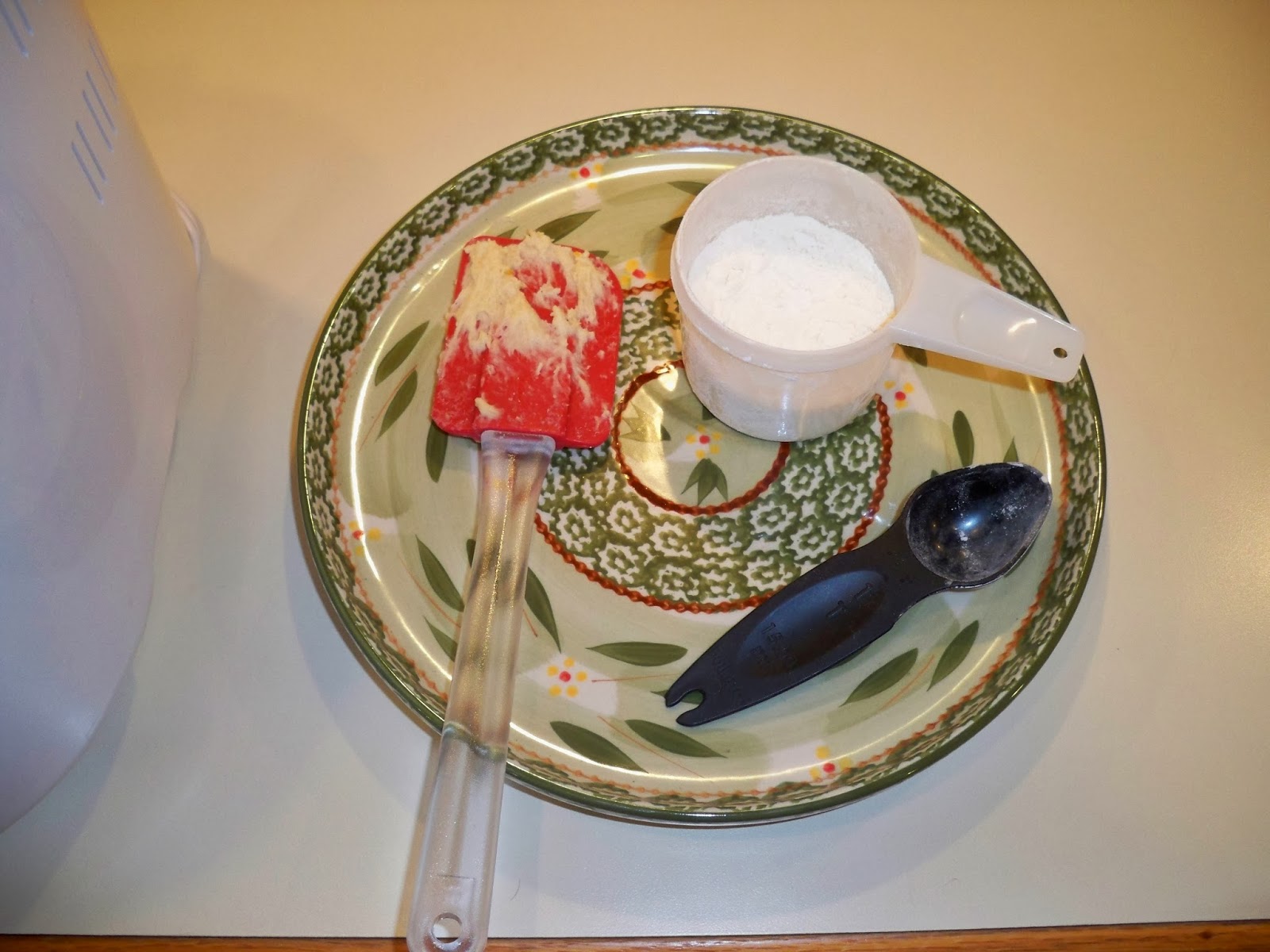
I sometimes have to add additional flour to this recipe during the beginning of the second knead cycle--a tablespoon at a time. I place a plate holding a silicone spatula, a tablespoon, and extra flour by the machine before I start it. Dough with nuts or fruit in it (like this one) needs to be a bit stickier than regular bread dough in order to help the nuts or fruit stay incorporated in the bread. That being said, this dough will stick to the side of the pan, but you know you've got enough flour in it when it pretty easily pulls away from the side with a spatula.
Here is the bread dough at a good consistency. It is slightly sticking to the side of the pan, but you can see that there is very little dough sticking elsewhere:
At the "add ingredient" tone, I added the cranberries. Here is a photo after I first put them in and then another photo after they had started incorporating into the bread. I used my spatula to help the machine mix the cranberries into the dough:
For my bread machine, the dough is shaped at 1 hour, 52 minutes. If I'm in the kitchen and hear the machine kick on to shape the dough around that time, I always lift the lid quickly, reposition the dough into the middle of the pan so that it rises evenly, and then close the lid. This will not diminish the rising/baking at all. If I don't happen to catch the machine at that time, my machine does a pretty good job of leaving the dough in the middle of the pan. It might not rise quite as evenly, but it will still look nice. Here is the dough after I repositioned it in the middle of the pan and also a photo of it when it has risen some and only has 45 minutes left to bake!
Done! :)
Friday, January 3, 2014
Taco Soup
Taco Soup is a great weeknight meal when you don't have much time to cook. You can have dinner on the table in an hour!
Taco Soup
1 lb. ground beef
1 cup chopped onion (1 medium)
2 (15.5 oz.) cans pinto beans (DO NOT DRAIN)
2 (14.5 oz.) cans stewed tomatoes (DO NOT DRAIN)
2 (15.25 oz.) cans whole kernel corn (DO NOT DRAIN)
1 cup of water
1 (1.0 oz.) envelope taco seasoning mix
1 (1.0 oz.) envelope Hidden Valley Ranch Salad Dressing & Seasoning Mix
optional toppings: cheddar cheese, sour cream, Fritos, green onions
Brown the beef and onion; drain. Add other ingredients chopping tomatoes until desired size. Simmer for about 30 minutes. Garnish with toppings.
Click here for printable format
Friday, December 27, 2013
Cheesy Refried Bean Dip
If you need an easy, delicious dip, this is it!
Cheesy Refried Bean Dip
This easy recipe comes from Temp-tations: http://www.temp-tations.com/recipe/cheesy-refried-bean-dip
Friday, December 20, 2013
Strawberry Pie
Could anything say Christmas dessert better than this beautiful pie? Now you can have strawberry pie any time of year and not just when strawberries are in season since this recipe uses frozen strawberries. Easy+Beautiful+Delicious=A Winner! Enjoy!
Strawberry Pie
1 (16 oz.) bag frozen whole strawberries*
1 (3 oz.) strawberry gelatin
1 cup sugar
4 tbsp. cornstarch
2 cups strawberry juice/water
1 (9") baked pie shell
whipped cream
1 cup sugar
4 tbsp. cornstarch
2 cups strawberry juice/water
1 (9") baked pie shell
whipped cream
Cut strawberries in half (or fourths if particularly large) while still frozen. Thaw strawberries in a strainer over a bowl to capture the strawberry juice. (There will only be a small amount of juice.) In a 3 qt. saucepan, mix gelatin, sugar, and cornstarch. Put the juice from the strawberries into a 2-cup measuring cup, and finish with water to equal two cups. Gradually add the juice/water mixture to the saucepan, and cook over medium heat stirring constantly until mixture is boiling and is clear and thick. Set aside and let cool until mixture is at room temperature. Add the thawed strawberries. Pour into a baked pie shell until full as there may be excess filling depending on the depth of the shell. Refrigerate 2-3 hours. Top with whipped cream before serving.
*If you can't find a 16 oz. bag, buy a 32 oz. bag of frozen, whole strawberries and use half of it.
Click here for printable format
Perfect Pie Crust: http://easyaspiecanbe.blogspot.com/2013/12/perfect-pie-crust-recipe-and-tutorial.html
Whipped Cream: http://easyaspiecanbe.blogspot.com/2013/12/whipped-cream-recipe-and-tutorial.html
This recipe was shared with me by friend Holly Hendrix.
Saturday, December 7, 2013
Whipped Cream Recipe and Tutorial
The finishing touch on any cream pie is
homemade whipped cream. This recipe, by Chef Anna Olson, has a special ingredient that stabilizes the cream but does not change the texture or taste. You can pipe it, you can dollop it--every swirl and swish will stay in place for several hours. You will never buy the stuff in the tub or can
after making and tasting this easy whipped cream recipe. Plus...I
include a tutorial on how to mound it on your pie for a
knock-your-socks-off presentation!
| A 16 oz. carton of heavy whipping cream is shown, but you will only need 1 cup (8 oz). |
1 cup (8 oz.) heavy whipping cream
1 tablespoon instant nonfat dry milk
3 tablespoons sugar
Place a metal, glass, or ceramic 3- or 4-qt. mixing bowl and beaters into the freezer for 10 minutes. Add all ingredients to the mixing bowl, and with an electric mixer at medium-high speed, beat just until the cream reaches stiff peaks and loses its gloss. Keep refrigerated.
Whipped Cream 101: Once you have whipped the cream for a minute or two, you’ll notice that the beaters leave trails. The longer you whip, the thicker and more noticeable these trails become. Most recipes call for either soft or stiff peaks. For soft peaks, if you lift up the beaters and look, the peak should curl down and melt back into the mound. For stiff peaks, keep beating until the peaks stand straight up and appear firm when beaters are lifted. For a great visual guide, click here.
Click here for printable format
*Stabilization tip given in Anna Olson's Top 10 Baking Questions Answered: https://www.foodnetwork.ca/baking/blog/anna-olsons-top-10-baking-questions-answered/
Note: I have a KitchenAid stand mixer, but I prefer to use a hand mixer for whipped cream and meringue. I feel it gives more control over the end product.
Placing Whipped Cream on a Pie Tutorial:
After following the above directions, your whipped cream should look like this:
Take a spoonful of cream, and place it where you would like your perimeter to be:
With the back of your spoon, apply light pressure, and spread the cream slightly outward, inward, and to the side to form a bigger, flatter section:
Take a second spoonful, and place it to the side of the first using the back of your spoon to spread the cream in the same way. Continue around the perimeter of the pie:
Fill the center with a spoonful of cream and slightly spread:
Repeat the process making your next layer of whipped cream slightly smaller in diameter:
Repeat with a third layer making the diameter smaller than the second layer:
Using the back of your spoon, push into the whipped cream while pulling up to make peaks:
Done! :)
If desired, add a decorative finish to the top of the whipped cream:
SaveSave
Placing Whipped Cream on a Pie Tutorial:
After following the above directions, your whipped cream should look like this:
Take a spoonful of cream, and place it where you would like your perimeter to be:
With the back of your spoon, apply light pressure, and spread the cream slightly outward, inward, and to the side to form a bigger, flatter section:
Take a second spoonful, and place it to the side of the first using the back of your spoon to spread the cream in the same way. Continue around the perimeter of the pie:
Fill the center with a spoonful of cream and slightly spread:
Repeat the process making your next layer of whipped cream slightly smaller in diameter:
Repeat with a third layer making the diameter smaller than the second layer:
Using the back of your spoon, push into the whipped cream while pulling up to make peaks:
Done! :)
If desired, add a decorative finish to the top of the whipped cream:
Friday, December 6, 2013
Perfect Pie Crust Recipe and Tutorial
The best pie crust recipe on the planet is The Pioneer Woman Cooks Perfect Pie Crust. Once you make it, you will make no other. It is flaky, tender, and has a wonderful taste. You make the dough ahead of time, and then freeze it, so it is ready when you are.
Click here for the recipe link and a wonderful tutorial
I divide Ree Drummond's recipe into halves, so I will have generous pie crusts. I freeze them for at least 24 hours before rolling them out. When I'm ready to use a crust, I remove one from the freezer and allow it to sit on the counter to thaw slightly...about 20 minutes. Then I remove it from the bag and get started! Here is my work station with everything ready to go: a spatula, pastry mat, rolling pin, water, flour, pie plate, and pie crust. If you don't have a pastry mat, just use your counter top! :)
Here is the amount of flour I put on the mat:
And here is the amount of flour I put on the dough:
Roll the dough from the center outward. It will split in places, and when it does, you just cup your hand around the outside edges, and push it back together:
Once it's slightly bigger than its original size, move it to the side with your spatula, lightly flour the area where the dough was, and flip the dough over onto the newly floured area. Add a dusting of flour to the top side, spread it over the dough with your hand, and continue rolling from the center outward. Keep the dough circular by occasionally pushing the edge in gently with sides of hands:
Roll the dough 2-3 inches larger than your inverted pie plate:
With the spatula, loosen the pie crust edges all the way around:
Using both hands, lift the crust and fit it into the pie plate:
It might tear in places. If it does, after it's in the plate, moisten the tear edges with water and press together. Put some flour on top of the tear to absorb the water. You can see several tears in this crust I had to fix:
Trim overhanging edge of dough 1 inch from rim of plate. Tuck the excess dough under itself above the rim:
Finish the edges as desired. I like to flute the edges. I place my index finger outside the pastry edge and knuckles on the inside. I pinch the pastry in a rounded V shape. I had to take the photos separately since I was the only photographer available. :)
After fluting, press the sides of the pie shell firmly against the sides and lower rim of the pie plate. You can see in the photo below where I've pressed the dough against the lower rim of the Fiesta pie plate. For a pre-baked crust, prick the crust all over with a fork, turn the oven on 400 degrees, and place the pie crust in the refrigerator for the dough to relax while the oven is heating. This will reduce shrinkage.
Place the crust in the oven when it reaches 400 degrees. Watch the crust. If it starts to puff up in the middle, just poke it with a fork. Here is my crust puffing up:
The crust will be done when it is lightly browned...about 20-25 minutes. Allow to cool, and then fill, or store it until the next day in an airtight container.
Pastry for Single-Crust Pie Baked with Filling: Do not prick pastry. Bake as directed in individual recipe.
Pastry for Double-Crust Pie: Roll out dough as described above, and fit into pie plate. Do not prick pastry. Trim pastry even with rim. For top crust, roll out a second crust, place desired pie filling into pie shell, top with pastry for top crust, and trim top crust 1/2 inch beyond edge of pie plate. Fold extra pastry under bottom crust; flute edge. Cut slits for escape of steam. Bake as directed in individual recipe.
Click here for the recipe link and a wonderful tutorial
I divide Ree Drummond's recipe into halves, so I will have generous pie crusts. I freeze them for at least 24 hours before rolling them out. When I'm ready to use a crust, I remove one from the freezer and allow it to sit on the counter to thaw slightly...about 20 minutes. Then I remove it from the bag and get started! Here is my work station with everything ready to go: a spatula, pastry mat, rolling pin, water, flour, pie plate, and pie crust. If you don't have a pastry mat, just use your counter top! :)
Here is the amount of flour I put on the mat:
And here is the amount of flour I put on the dough:
Roll the dough from the center outward. It will split in places, and when it does, you just cup your hand around the outside edges, and push it back together:
Once it's slightly bigger than its original size, move it to the side with your spatula, lightly flour the area where the dough was, and flip the dough over onto the newly floured area. Add a dusting of flour to the top side, spread it over the dough with your hand, and continue rolling from the center outward. Keep the dough circular by occasionally pushing the edge in gently with sides of hands:
Roll the dough 2-3 inches larger than your inverted pie plate:
With the spatula, loosen the pie crust edges all the way around:
Using both hands, lift the crust and fit it into the pie plate:
It might tear in places. If it does, after it's in the plate, moisten the tear edges with water and press together. Put some flour on top of the tear to absorb the water. You can see several tears in this crust I had to fix:
Trim overhanging edge of dough 1 inch from rim of plate. Tuck the excess dough under itself above the rim:
Finish the edges as desired. I like to flute the edges. I place my index finger outside the pastry edge and knuckles on the inside. I pinch the pastry in a rounded V shape. I had to take the photos separately since I was the only photographer available. :)
After fluting, press the sides of the pie shell firmly against the sides and lower rim of the pie plate. You can see in the photo below where I've pressed the dough against the lower rim of the Fiesta pie plate. For a pre-baked crust, prick the crust all over with a fork, turn the oven on 400 degrees, and place the pie crust in the refrigerator for the dough to relax while the oven is heating. This will reduce shrinkage.
Place the crust in the oven when it reaches 400 degrees. Watch the crust. If it starts to puff up in the middle, just poke it with a fork. Here is my crust puffing up:
The crust will be done when it is lightly browned...about 20-25 minutes. Allow to cool, and then fill, or store it until the next day in an airtight container.
Pastry for Single-Crust Pie Baked with Filling: Do not prick pastry. Bake as directed in individual recipe.
Pastry for Double-Crust Pie: Roll out dough as described above, and fit into pie plate. Do not prick pastry. Trim pastry even with rim. For top crust, roll out a second crust, place desired pie filling into pie shell, top with pastry for top crust, and trim top crust 1/2 inch beyond edge of pie plate. Fold extra pastry under bottom crust; flute edge. Cut slits for escape of steam. Bake as directed in individual recipe.
Subscribe to:
Comments (Atom)